

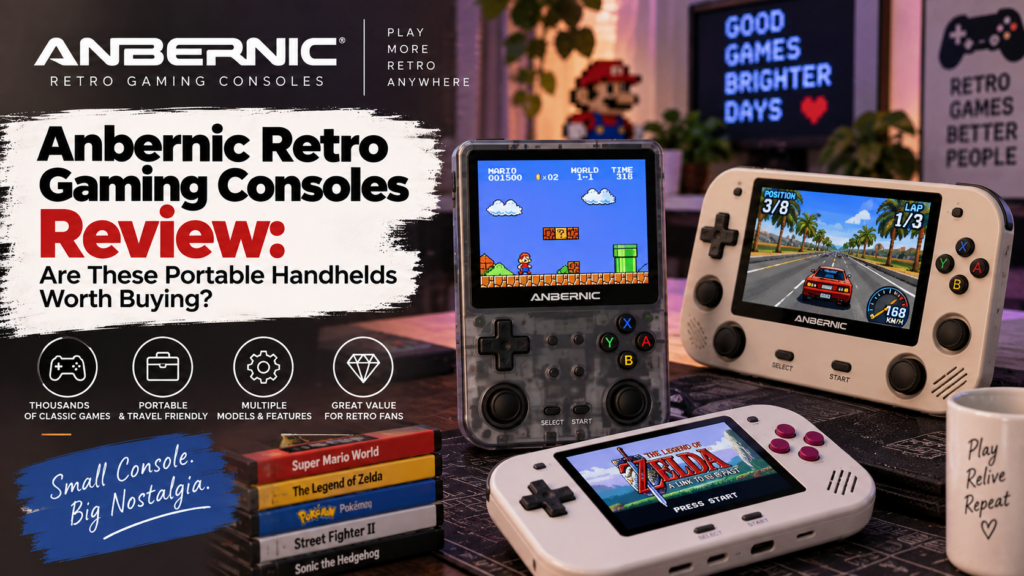
Anbernic Retro Gaming Consoles Review: Are These Portable Handhelds Worth Buying?
Disclosure: This post may contain affiliate links. If you make a purchase through one of these links, I may earn a commission at no additional […]
Anbernic Gaming Consoles Review: Are These Retro Handhelds Worth Buying?
The retro gaming landscape has exploded in recent years, evolving from clunky desktop emulators into sleek, pocket-sized hardware. Among the brands driving this movement, Anbernic has emerged as one of the most prominent manufacturers of portable emulation consoles.
Known for pairing vintage console form factors with modern display panels and open-source operating systems, Anbernic offers a vast catalog ranging from budget vertical devices to powerful widescreen Android handhelds. This review takes a deep look into what makes Anbernic devices popular, how their feature sets perform, and how to choose the right model for your gaming needs.
What Makes Anbernic a Dominant Name in Retro Gaming?
Unlike off-brand emulation devices that rely on low-quality plastic and fixed, unupgradable game lists, Anbernic builds purpose-driven hardware designed to run Linux or Android-based emulation frontends. This allows players to load their own game backups, customize firmware, and adjust aspect ratios for an authentic visual experience.
Another key driver of Anbernic’s popularity is form-factor variety. Whether you prefer vertical layouts reminiscent of classic 90s Game Boys, horizontal layouts for ergonomic play, clamshell designs, or dual-screen configurations, the brand maintains a dedicated lineup covering almost every mechanical preference.
Key Features Across the Anbernic Product Range
While specific processors and screen sizes vary across models, several core characteristics define the Anbernic hardware ecosystem:
Vibrant IPS & OLED Displays
Equipped with high-density IPS touchscreens or vibrant OLED panels tailored to retro aspect ratios (such as 4:3 for classic consoles or 16:9 for modern system scaling).
Tactile Controls & Build Quality
Features responsive D-pads, precise analog sticks (often utilizing Hall-effect sensing to eliminate drift), and sturdy shells available in plastic or premium CNC aluminum.
Dual OS & Firmware Flexibility
Depending on the chipset, devices run lightweight Linux distributions for quick plug-and-play gaming or Android operating systems for expanded app ecosystems.
Expandable Storage & Connectivity
Includes dual micro-SD card slots for separate OS and game storage, along with Wi-Fi, Bluetooth, and mini-HDMI output for TV play on select models.
Hardware & Ecosystem Highlights
- Broad Emulation Scope: Capable of playing systems ranging from 8-bit classics up to 32-bit, 64-bit, and mid-tier 3D platforms depending on the processor tier.
- Active Community Support: Compatible with popular community-developed custom firmware options that improve performance and UI navigation.
- Portability Focus: Compact designs with rechargeable lithium-ion batteries providing 4 to 8 hours of continuous play.
Practical Considerations Before Buying
Navigating Anbernic’s extensive catalog requires understanding a few practical factors before making a purchase:
- Understanding Chipset Tiers: Lower-tier devices excel at 8-bit, 16-bit, and PS1 emulation, while higher-tier ARM and Unisoc chipsets are required for demanding 3D platforms. Choose based on the specific generation of games you want to play.
- Game File Management: While devices often ship with system micro-SD cards, retro enthusiasts generally recommend using high-quality brand-name SD cards and managing your own legally obtained ROM library for long-term stability.
- Initial Setup Curve: While basic navigation is simple out of the box, optimizing settings, screen shaders, and button mappings occasionally requires light tinkering.
Who Is an Anbernic Console Best Suited For?
Anbernic handhelds cater to several distinct types of gamers:
- Nostalgia Seekers: Players who grew up in the 80s, 90s, or 2000s wanting to relive classic console experiences in a dedicated portable device.
- Commuters & Travelers: Anyone looking for pocket-friendly entertainment without draining their primary smartphone battery.
- Retro Gaming Enthusiasts: Collectors and tinkers who enjoy customizing frontends, trying custom firmwares, and curating portable game libraries.
Price, Value & Final Assessment
Anbernic handhelds cover a wide price spectrum, generally starting around $40 to $60 for entry-level pocket devices and scaling up to $150–$200+ for high-performance metal or dual-screen Android models.
Compared to mainstream modern handhelds, Anbernic offers exceptional hardware value per dollar for retro enthusiasts. You get tactile physical controls, quality display panels, and dedicated retro hardware without paying a high brand markup.
Final Verdict: Are Anbernic Consoles Worth It?
Anbernic has earned its solid reputation in the retro gaming market by delivering reliable hardware, excellent controls, and versatile display choices. Whether you are looking for a simple $50 nostalgia machine for 16-bit classics or a versatile Android-powered handheld for broader emulation, Anbernic provides one of the most complete and satisfying product lines available today.
Explore the Official Anbernic Store
Find full specifications, color options, and current store promotions directly on the official site.

Why Is Ocoopa Trending in 2026? Rechargeable Hand Warmer Review
September 18, 2026
EPOMAKER Review 2026: Is This Mechanical Keyboard Store Worth It?
September 15, 2026
Why Is Arzopa Trending in 2026? Portable Monitor Analysis
September 14, 2026